Fragmented Information
Data lives in silos and does not connect to decisions
The IsoForm helps organizations make clearer operational and strategic decisions by converting fragmented information, competing priorities, and uncertainty into standardized decision structures that can be executed like clockwork
The Problem
Organizations operate with fragmented data, competing priorities, and ad-hoc decisions
The result: misalignment, delays, waste, and inconsistent outcomes
Data lives in silos and does not connect to decisions
Too many priorities Not enough clarity on what matters most
Decisions are made with incomplete information and shifting conditions
Teams interpret goals differently and pull in different directions
Decisions vary by person, team, or context—leading to unreliable results
The Solution
The enterprise model provides continuous strategic coherence by continuously governing the alignment between strategy, decisions, execution, and outcomes across the organization.
Adaptive Learning
The framework does not attempt to predict reality perfectly from the start Instead, real-world outcomes continuously refine the weighting structure over repeated cycles
Behind every iconic company is a handful of decisions that changed everything. Explore the stories behind some of the world's most consequential business moments—and the decision gaps they reveal.

One strategic transition. Decades of identity. Countless competing pressures. How do you change without becoming something else?
Read Story
There was a time when buying a mobile phone meant buying a Nokia. Success wasn't the problem—it became the benchmark against which every future decision was measured.
Read Story
There was a time when photography meant Kodak. Kodak invented the digital camera—yet protecting film's success made the future harder to embrace.
Read Story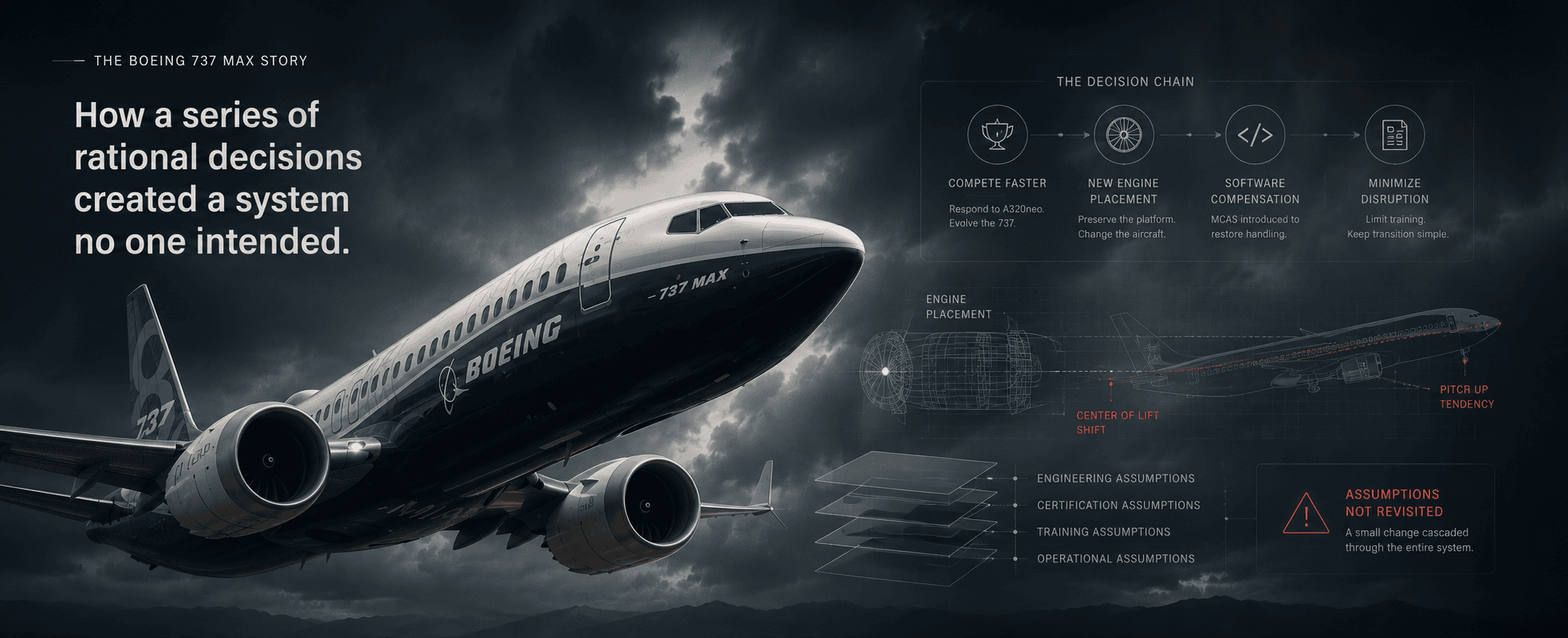
The Boeing 737 MAX wasn't undone by one bad call. Each decision was rational—yet together they built a system nobody intended, because yesterday's assumptions were never challenged again.
Read StoryThe IsoForm is designed for organizations operating under competing priorities, constrained resources, multi-project execution pressure, and operational ambiguity

Structuring large-scale staffing demand across concurrent AI operations, annotation workflows, evaluation pipelines, and research projects to improve allocation speed, capability matching, and workforce utilization
Read Technical Case →
Standardizing dispatch decisions across high-volume last-mile delivery operations to improve routing efficiency, reduce dead-mile allocation, and optimize delivery window performance under real-time operational constraints
Read Technical Case →
Structuring warehouse expansion decisions across shipping corridors, transit dependencies, and fulfillment timelines to determine operationally optimal logistics network placement
Read Technical Case →
Standardizing enterprise project pipelines into comparable execution signals to help PMO leadership decide which initiatives should continue, pause, accelerate, or receive strategic allocation priority
Read Technical Case →Organizations typically engage The IsoForm when critical decisions are slowed by competing priorities, resource constraints, governance complexity, or unclear decision-making structures. We help leadership teams create a clear operating architecture for prioritization, resource allocation, governance, and execution
Discovery
Assess constraints, decision challenges, and organizational objectives
Framework Design
Define the structural logic that will govern decisions
Structural Modeling
Translate the architecture into a repeatable decision framework
Operationalization
Integrate the framework into governance and execution processes
Learning & Refinement
Improve the framework based on outcomes and operational feedback
The IsoForm platform operationalizes the framework, allowing organizations to execute structured decisions consistently and transparently
If critical decisions are becoming harder to make, align, or execute, let's talk
Headquarters
New Delhi, India