Nokia: The Symbian Commitment
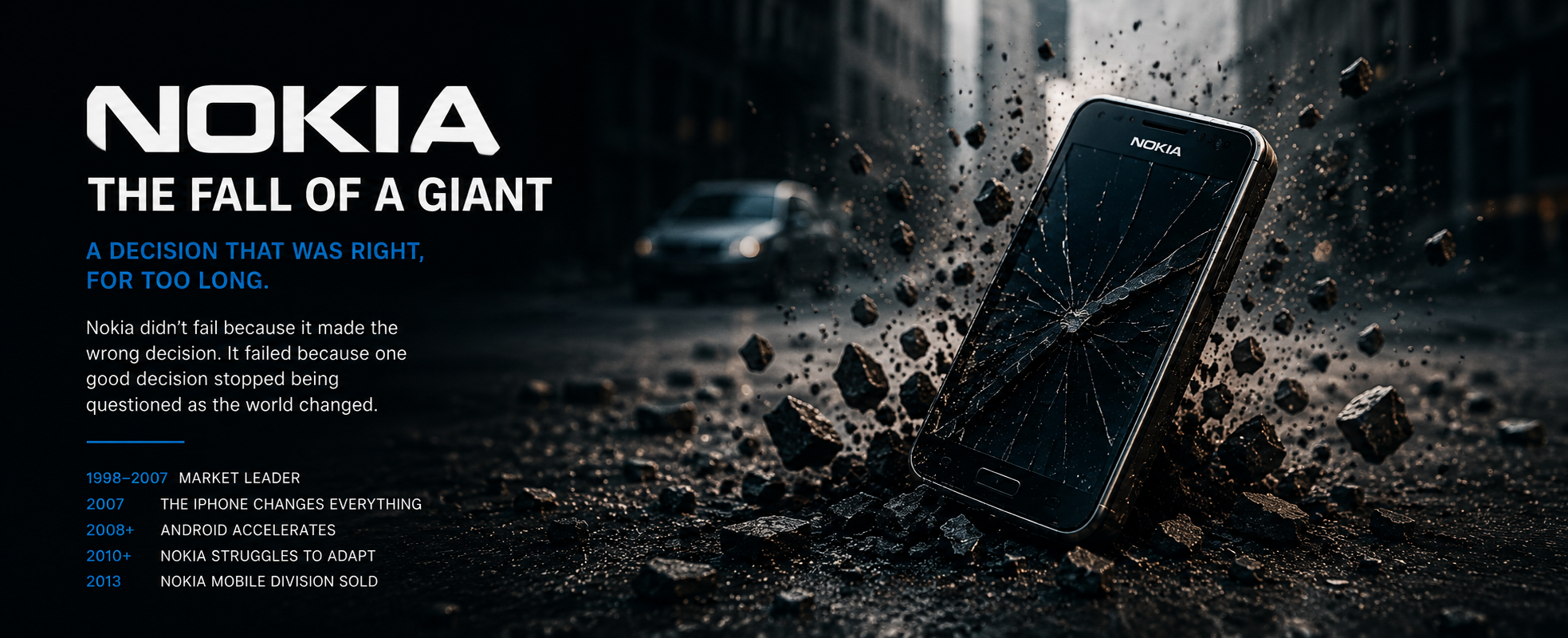
Nokia: The Symbian Commitment
There was a time when buying a mobile phone meant buying a Nokia.
It wasn't simply the market leader. It defined the market.
By the mid-2000s, Nokia controlled almost half of the global smartphone market. Symbian powered hundreds of millions of devices, developers built around it, operators trusted it and consumers expected it. For years, the strategy worked exactly as intended.
Success wasn't the problem.
It became the benchmark against which every future decision was measured.
01A strategy built for a different world
In 2007, Apple introduced the iPhone. A year later, Android arrived.
The smartphone was no longer evolving as a better mobile phone. It was becoming a software platform, an application ecosystem and a developer economy. The basis of competition had fundamentally changed.
For Nokia, this wasn't simply another competitor entering the market.
It was an entirely different game.
The challenge wasn't building a better phone anymore. It was building a better ecosystem.
02Reality rarely changes overnight
Markets don't usually collapse overnight.
They change quietly.
Developers begin building elsewhere. Customers start expecting different experiences. Applications become more valuable than hardware features. Touch interfaces redefine usability. Software updates become as important as the device itself.
Individually, every signal appears manageable.
Collectively, they describe an entirely different industry.
The challenge isn't recognizing one signal.
It's recognizing when hundreds of small signals have become a new reality.
03Success creates its own gravity
Symbian wasn't a bad decision. It had earned its place. It helped Nokia become the world's largest mobile phone manufacturer and one of the world's most valuable technology companies.
The difficulty wasn't choosing Symbian.
It was questioning a strategy that had already proven itself.
Every successful organization eventually reaches this point.
When does confidence become certainty?
When does certainty become attachment?
Eventually the question stopped being:
Is Symbian successful?
It became:
Is Symbian still where the future is heading?
Those are fundamentally different questions.
04The cost of changing kept increasing
As the years passed, changing direction became increasingly difficult. Products depended on Symbian. Engineering teams depended on it. Roadmaps depended on it. Partners depended on it.
Every additional investment reinforced the previous one until changing direction no longer meant changing software.
It meant changing the company itself.
By the time Nokia announced its transition to Windows Phone in 2011, iOS and Android had already become the dominant smartphone ecosystems. Two years later, Microsoft acquired Nokia's Devices & Services business.
None of those decisions happened overnight.
They were the outcome of years spent adapting while the basis of competition continued to move.
05Looking back
Looking back, the question isn't whether Symbian was the right decision.
For years, it unquestionably was.
The more interesting question is what happens when a strategy that creates extraordinary success begins operating in a world it was never designed for.
The market evolved. Nokia evolved with it. But the basis of competition evolved faster.
The challenge was never building a better phone.
It was recognizing that the definition of a better phone had fundamentally changed.
When does yesterday's winning strategy stop preparing you for tomorrow?
The Crossroads
Every organization eventually reaches its own crossroads. Sometimes it's technology, sometimes regulation, sometimes growth, sometimes identity.
The companies change. The industries change. The decisions change.
The underlying challenge rarely does.
Every critical business function has a Standard Operating Procedure.
Why don't decisions?
Explore the ISOFORM Framework →